

This article was written by Stephen Merrett, one of the Life Beyond Work peer convenors and a guest blogger for this month. Stephen has been navigating his own ‘life beyond work’ journey for over ten years and has been an active peer co-designer of the Life Beyond Work program throughout that time.
How a growth mindset, sense of purpose and pursuit of Joyspan can transform your years beyond work.
Most of us have grown up with a single measure of a life well lived: how long it lasted. But longevity researchers and gerontologists are converging on a more nuanced, and more hopeful, picture. A fulfilling later life isn’t just about the years you accumulate. It’s about what happens inside them.
Three concepts, taken together, tell a richer story.
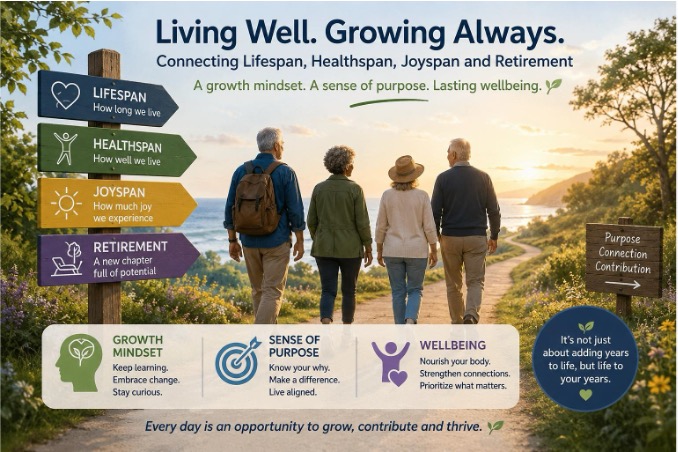
Lifespan is the familiar one: the total years from birth to death. Modern medicine has extended it dramatically, but length alone tells us nothing about the quality of the time contained within it.
Healthspan sharpens the picture — the years lived with sufficient physical and cognitive function to engage actively with the world. The uncomfortable truth is that Healthspan typically ends before Lifespan does, often by a decade or more. We have become skilled at keeping people alive, but less skilled at keeping them well.
Joyspan is perhaps the most radical of the three. Coined by gerontologist Dr Kerry Burnight, it refers to the period of life characterised by active engagement, curiosity, connection, and meaning. What makes Joyspan distinctive is that it doesn’t simply track health. A person with significant physical limitations can have a rich and purposeful Joyspan, while someone in robust health can be living in quiet emptiness. Joyspan is not given to us. It is built, gradually and intentionally.
A person with significant physical limitations can have a rich and purposeful Joyspan, while someone in robust health can be living in quiet emptiness. Joyspan is not given to us. It is built, gradually and intentionally.
Stephen Merrett
‘Retirement’ changes everything
Retirement – moving into life beyond work – is the moment these three spans diverge most visibly. For decades, work has provided the scaffolding of a life: identity, routine, social connection, purpose and contribution. When that structure falls away, many people discover, often with surprise, that they hadn’t built much to underpin it.
The Healthspan window in the early years after leaving work can be generous: ten, fifteen, perhaps twenty years of good functional capacity. But if those years are spent gradually disengaging, Joyspan can be quietly eroded long before health demands it. The question isn’t simply “how long will I live?”, or even “how healthy will I be?” It’s “what will I be living for?”
Growth mindset, purpose, and wellbeing as the response
Carol Dweck’s concept of the growth mindset, the belief that abilities and potential can be developed through effort and curiosity, turns out to be one of the most important things a person can carry into later life. It determines whethernew experiences feel threatening or interesting, and whether setbacks are met with grief or genuine exploration.The mindset doesn’t prevent decline. It determines how we respond to it. Meaning is not a luxury, it is increasingly understood to be a biological necessity.
A strong sense of purpose is associated with lower rates of cognitive decline, reduced cardiovascular risk, and longer Healthspan, not merely Lifespan. In life beyond work, purpose must be self-created rather than externally assigned.
Dr Burnight’s four pillars offer a practical framework:
Grow (keep learning)
Connect (deepen relationships)
Adapt (respond to change flexibly)
Give (contribute beyond yourself).
Wellbeing, in turn, is the measure of how well the whole system is functioning. Research in positive psychology consistently finds that its key contributors – relationships, engagement, mastery, and meaning – can be cultivated at 70 or 80 just as readily as at 40, and that wellbeing in life beyond work is substantially a product of intention rather than circumstance.
A different kind of ambition
The years we live after leaving work, reimagined through this lens, call for ambition of a different kind, not for status or accumulation, but for depth: deeper relationships, deeper engagement with ideas, deeper contribution and connection to community.
A long life is a starting point, not an achievement. A healthy life is a foundation, not a destination. And a joyful life, built on growth, connection, adaptation, and generosity, is something we construct, deliberately, until we can’t. That building, as it turns out, is the point.
Further reading
Kerry Burnight’s work on the four pillars of Joyspan; Carol Dweck, Mindset (2006); Martin Seligman, Flourish (2011).
Editing note: Stephen has used Claude as a trusted AI tool in the initial drafting of this article, combining it with his own lived experience and independent online research to create this final version.)